

Introduction
They say time heals all wounds but what about the kind of pain that lingers in your chest long after the world has moved on? The kind that no one sees, but you feel every time you’re quiet enough to hear your own thoughts?
I used to believe that healing just meant waiting. That if I stayed busy long enough, distracted myself deeply enough, and gave it “enough time”… the pain would fade. But after five years of studying emotional health, feminine energy, and the psychology of healing, both in my own life and in the lives of women around me. I’ve realized a deeper truth:
Time doesn’t heal you. You do.
But time gives you the space to finally choose yourself.
In this blog, we’re going to explore what “time heals all wounds” really means and why it’s only half the truth. I’ll share what actually heals heartbreak, betrayal, grief, and emotional exhaustion especially when time alone isn’t working. I’ll also break down how to use time as your healing ally, instead of hoping it will fix what you never faced.
If you’re done pretending you’re okay and ready to start actually feeling better this post is for you.
1. The Origin of “Time Heals All Wounds”
The comforting phrase “time heals all wounds” traces back more than two millennia to ancient Greece. The playwright Menander (c. 342–290 B.C.) wrote that “time is the healer of all necessary evils,” suggesting that the passage of time brings relief from suffering. Later, even the Roman poet Terence penned a similar Latin phrase translating to “time assuages human ailments”.
Through the centuries, this sentiment persisted in literature, proverbs, and daily conversation as a universal balm for emotional pain. Today, it’s still quoted to comfort someone after heartbreak, loss, or grief hoping that simply waiting will bring healing.
2. What Does “Time Heals All Wounds” Really Mean?
At its core, Time Heals All Wounds implies that emotional pain lessens as time passes. The idea is comforting: grief softens, heartbreak dulls, and sorrow becomes more manageable over time.
But the phrase also holds a dangerous assumption that time alone does the work. Many people cling to it as a promise: wait long enough, and you’ll be healed. Unfortunately, research shows that unless pain is actively processed, time may only obscure it, not resolve it.
3. Is Time Enough? What Psychology and Science Reveal
Modern psychology confirms: time alone rarely heals deep emotional wounds. A Psychology Today analysis states clearly that time can soften pain, but real healing requires active effort—reflection, processing, and support.
A study of grief and bereavement found that distress typically decreases over years, but for many, pain and attitudes toward loss are mediated by how they cope, with time being just one part of the equation.
Other research highlights that putting emotions into words through journaling or talking can dramatically accelerate healing. People who spoke or wrote about their breakup for several hours over weeks reported better mental well-being than those who avoided deeper reflection.
Additionally, self-help experts emphasize that processing, not ignoring pain leads to emotional recovery, growth, and resilience. True healing often leads to post-traumatic growth, where pain becomes a catalyst for deeper insight, meaning, and transformation—something ordinary time cannot deliver on its own.
4. What Time Alone Doesn’t Heal
Here’s the uncomfortable truth I learned the hard way:
Time doesn’t heal what you refuse to feel.
And it definitely doesn’t heal what you keep repeating.
A friend of mine went through a painful breakup. She kept saying, “I just need time.” A year passed. Then two. But nothing changed—because she never actually processed the pain. She avoided it. She distracted herself. She stayed busy. But she never sat with the grief, the fear, or the truth. The wound wasn’t healing. It was hiding.
Here’s what time cannot heal on its own:
- Suppressed emotions: Bottling your feelings just makes them leak in other ways—like anger, numbness, or emotional detachment.
- Unhealed trauma: Time doesn’t automatically rewrite your nervous system. Trauma must be processed, not just endured.
- Toxic patterns: If you keep dating the same emotionally unavailable partner or ignoring red flags, time won’t stop the cycle—you will.
- Unspoken grief: Loss needs a voice. When you pretend to be fine, healing delays. Silence protects pain—not you.
If you’re waiting for time to do the work for you, you’ll wait forever. Healing is a choice you must make with time—not because of it.
Related: What To Do When You Have No One To Talk To: 4 *realistic* Ways.
5. What Actually Heals?
Healing isn’t passive. It’s an inner decision to meet yourself where you are—even when it’s messy. Time can be a beautiful support system, but the heavy lifting? That’s on you.
Here’s what actually heals:
1. Feeling to Heal
Let yourself cry. Let the anger rise. Let the grief shake you. Emotions are energy—they need motion. Don’t suppress. Express.
2. Reflective Practices
Journaling, especially daily, helps you untangle emotional confusion. Ask yourself:
- What am I still holding on to?
- What is this pain trying to teach me?
It’s not about fixing anything overnight—it’s about understanding yourself.
3. Nervous System Regulation
Healing happens when your body feels safe. Breathwork, grounding, prayer, and rest signal to your system: “I am safe now.” Only then does deep emotional repair begin.
4. Reframing Your Story
Pain can either define you—or refine you. When you shift the story from “Why did this happen to me?” to “What did this awaken in me?”—you reclaim your power.
5. Connection and Support
You’re not meant to heal alone. Whether it’s a therapist, a spiritual teacher, or a soul sister—let yourself be seen. Healing accelerates when you feel held.
“Time heals all wounds” is only true if you’re walking alongside it—doing the quiet, sacred, uncomfortable work of growth.
Related: 10 *helpful* Things To Do When You Feel Like Doing Nothing.
6. When Healing Feels Too Slow
Let’s be honest, there’s nothing more frustrating than thinking you should be over something by now… but you’re not.
The world moves on. Your friends stop asking. Life expects you to “get back to normal.”
But inside? You’re still aching.
I’ve had moments where I thought, “What’s wrong with me? It’s been months, why do I still feel this way?”
Here’s what I’ve realized: healing doesn’t follow the timeline your mind wants. It follows the depth of the wound and your emotional capacity to face it.
Some wounds are paper cuts. Some are deep soul gashes. You can’t rush the latter.
The worst thing you can do is judge yourself for not healing “fast enough.”
That’s not healing. That’s pressure.
So if you’re asking, “Does time heal?” the answer is yes, but only when you stop using time as a deadline and start using it as a gentle container for your becoming.
Related: How to *realistically* Cope With Loneliness.
7. How to Use Time as a Tool for Healing
Time is neutral. It can either numb you or nourish you. The choice is yours.
Instead of waiting for time to “do the healing,” what if you treated time like a sacred space to deepen into yourself?
Here are gentle ways to let time work with you:
- Create a healing routine: Whether it’s journaling in the morning, taking walks in silence, or setting boundaries around social media, rituals create consistency in chaos. Related: Right Way To Start Journaling For Tough Times.
- Reflect at milestones: Check in monthly with yourself. Ask: What hurts less now? What have I learned? What needs more love?
- Stay present: The mind clings to the past and fears the future. But healing? It lives in now. Practice mindfulness, even for 2 minutes a day.
- Speak your truth: Don’t fake strength. Give your pain a voice. Even whispered truths can shift energy.
- Give yourself grace: You’re not “behind.” You’re healing in human time, not hustle time.
So yes, time heals all wounds when you partner with it, not passively wait for it.
21-Day Unbothered Challenge:
To Ditch stress, ignore negativity & own your power, Take the 21-day Unbothered Challenge . Transform your mindset & relationships in just 21 days – guaranteed results!
Get your copy Here.
8. Time Doesn’t Erase, It Transforms
People often think healing means “going back to how you were before.” But that’s not healing—that’s denial.
Healing isn’t about erasing the pain.
It’s about integrating the experience so it no longer controls you.
Time may not make you forget, but it can help you transform the memory. What used to break you may now become the thing that built your strength, shaped your boundaries, or reawakened your worth.
I know women who’ve survived abandonment, betrayal, divorce, trauma, and today, they shine with a softness and strength that only comes from deep healing.
The wound became their teacher. And time was the classroom.
So if you’re still hurting, don’t panic.
You’re not broken. You’re becoming.
Let the scar be proof you survived.
10 Key Takeaways: Time Heals All Wounds
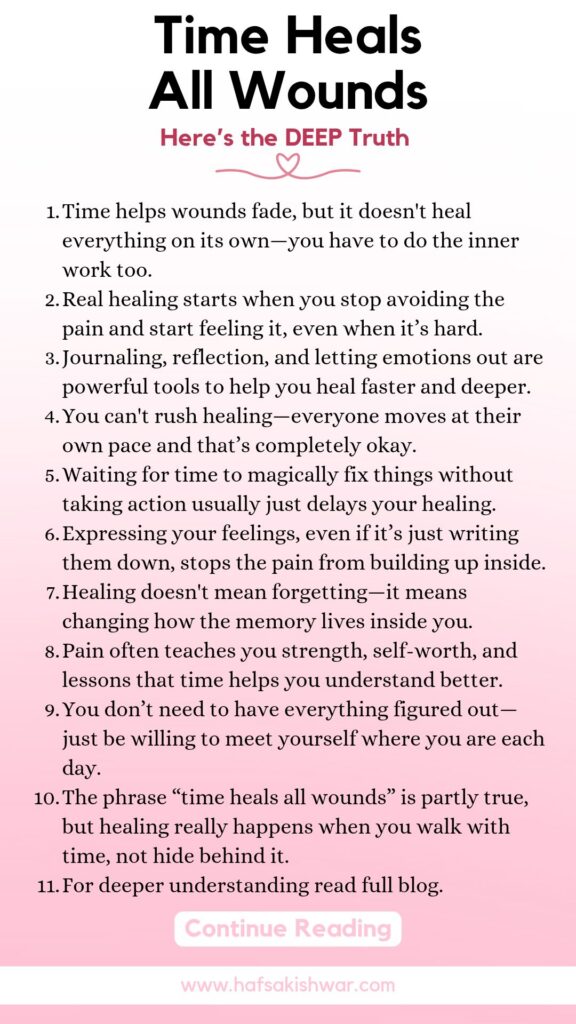
- Time alone isn’t enough to heal emotional pain.
Waiting doesn’t always make pain disappear. Time can make the hurt softer, but if you don’t deal with your feelings, they just stay hidden. Healing comes when you face your pain, not when you run from it. Time can help—but only when you help yourself, too. - The phrase “time heals all wounds” is comforting, but not complete.
It sounds nice, but it can make people believe they don’t have to do anything. Real healing needs your effort, not just the clock ticking. Time gives you space, but you have to choose how to use it. - Suppressed emotions don’t disappear over time.
If you avoid your feelings or try to stay busy all the time, the pain just goes deeper. You might feel numb or angry later. Facing your emotions is what actually helps you let go and feel free. - Your healing doesn’t have a deadline.
There’s no “right” time to be over something. Some people heal in months. Others need years. That’s okay. Don’t rush yourself. Your journey is your own, and healing takes the time it takes. - Time works best when paired with inner work.
Doing things like journaling, meditating, talking to someone, or crying it out can help you heal faster. Time helps when you’re doing the work, not avoiding it. - Pain can become your biggest teacher.
The things that hurt you can also teach you the most. After healing, many people feel stronger, wiser, and more confident. You grow from pain—when you use time to learn, not just wait. - You’re not broken if you’re still hurting.
Just because it’s taking time doesn’t mean something’s wrong with you. Everyone heals at their own pace. It doesn’t mean you’re weak. It means you’re human—and growing. - Healing feels slow—but small steps matter.
Even when you don’t see big changes, small things like resting, journaling, or talking about your pain are helping you move forward. Every little bit counts, even on quiet days. - Time gives you space to reflect and reset.
It can help you think more clearly, breathe deeper, and gain new understanding. But only when you use that time to slow down and listen to yourself. - You can heal and still carry the memory.
Healing doesn’t mean forgetting. It means you’ve made peace with the past. You can move on while still remembering what made you stronger. Your scars tell a story of survival.
Follow my blog for more heart-healing truths, mindset shifts, manifestation secrets, and emotional intelligence tools that actually work.
I share raw, real, and powerful insights to help you grow in love, life, and self-worth.
Do you think time alone is enough to heal pain?
I’d love to hear your thoughts 👇